Three things landed: HTTPS steps, agents in pipelines, charts on request
Three features landed close together, and they are more interesting combined than apart. Short version here; a worked use case for each will follow.
Same format as always: what changed, why it matters, and what is still missing.
An HTTPS step: pipelines can reach things that are not databases
A pipeline step can now make an HTTPS request. Save the request once — URL, method, headers, body — and any pipeline can call it.
That sounds small. What it removes is the gap you used to fall into at the edge of a pipeline: everything up to the warehouse was automated, and then somebody had to tell another system about it.
- Kick off work elsewhere. The load finishes, the step calls your API, the downstream job starts. Nobody is watching a clock.
- Tell a system it happened. A webhook when the nightly run completes, or when an assertion fails.
- Read what no database holds. An exchange rate, a job's status, a price, a list that only exists behind someone's API.
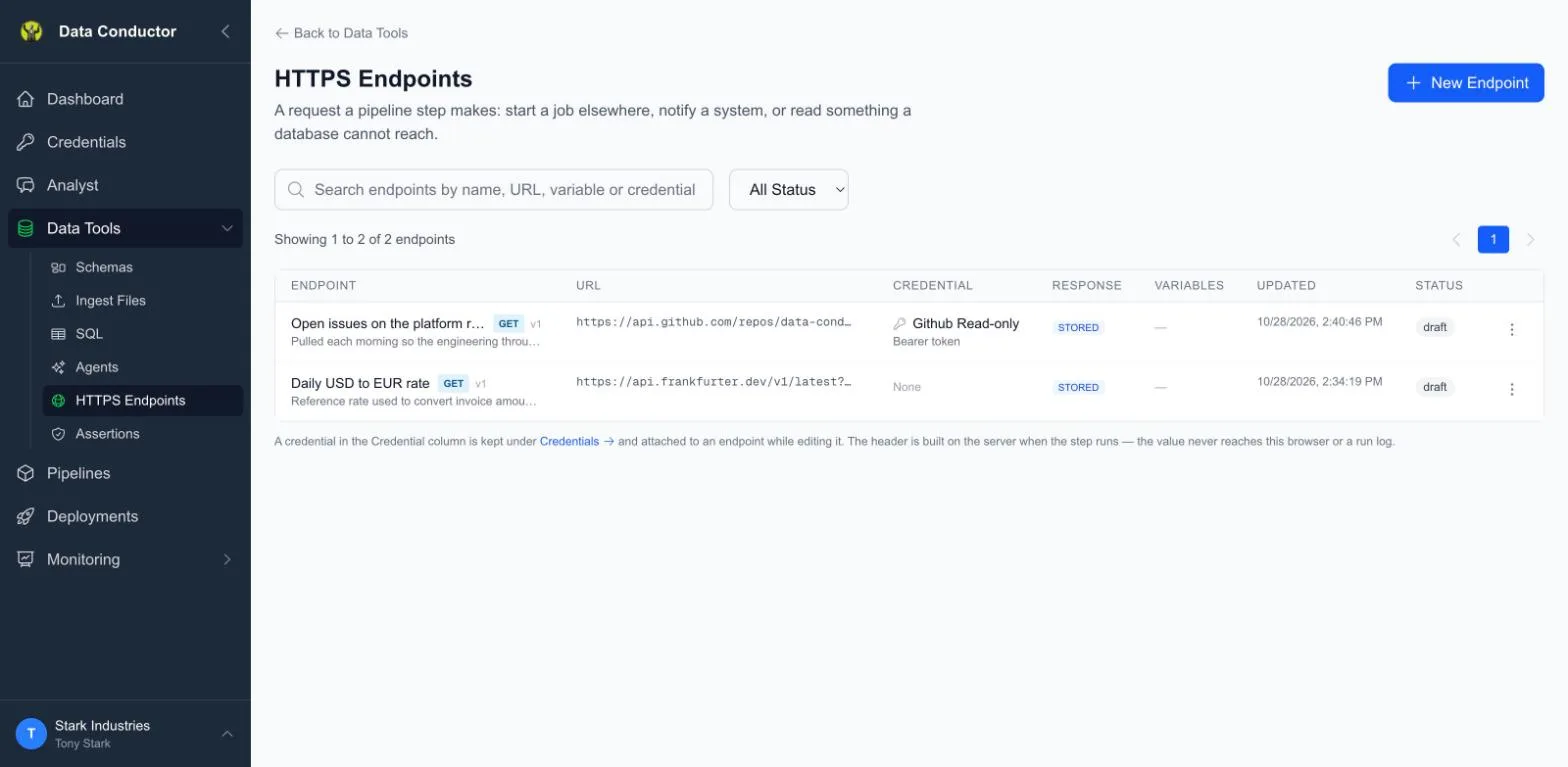
Tokens are handled as credentials: the header is built on our servers at the moment the request goes out, so the value never reaches your browser, never appears in a run log, and is never echoed back by the test panel. You can restrict a credential to the hosts it may be sent to, and an endpoint pointing anywhere else is refused — while you are editing, and again at run time.
The most useful thing to put behind an endpoint is usually a small function you wrote. There is a contract worth knowing before you write it, and templates for GCP, AWS and Azure.
Not there yet: no automatic retries, and a step calls once rather than waiting on slow work. For a job that takes minutes, return an identifier and check it in a later step — the pattern is documented.
Agents in pipelines: a step that reads the data and decides
An agent step is a prompt your pipeline runs. It takes declared inputs from the step before it, answers in a shape you specify, and the steps after it can branch on what it decided.
The case that makes it click is the one nobody has a good answer for: the load that is odd rather than wrong. Revenue down a third. Three thousand rows short. Assertions catch what you can write a rule for; this is for the rest, where the judgement used to be yours at 08:15.
- Decide whether to publish, and route the run accordingly
- Summarise what changed, in a form a later step can carry
- Classify rows, one field at a time, for the step that follows
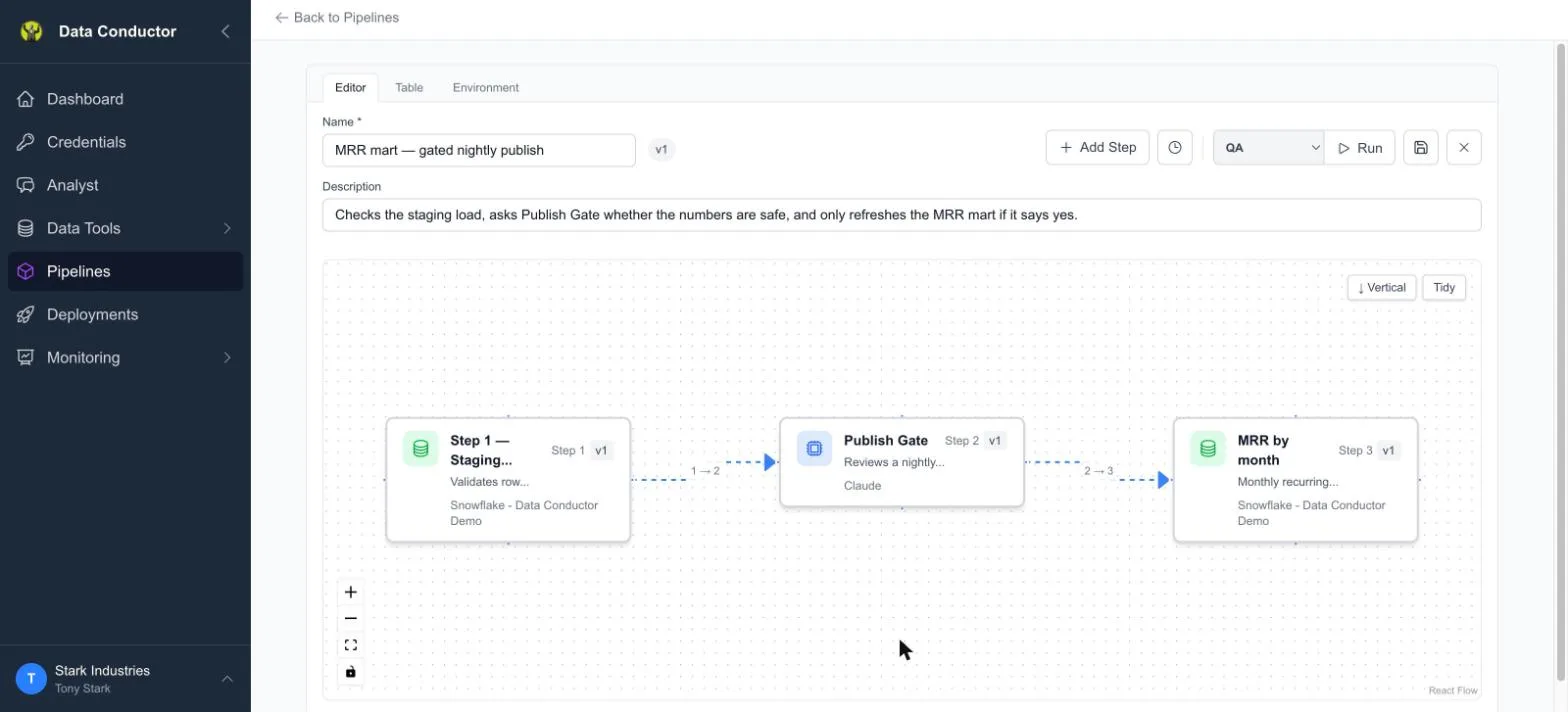
It runs on your model credential — Claude, Gemini, OpenAI, Grok or Perplexity, your key, your account. We are not in the middle of it.
Not there yet: an agent step evaluates what it is given. It does not query your database on its own, and that is deliberate.
Charts, including by asking
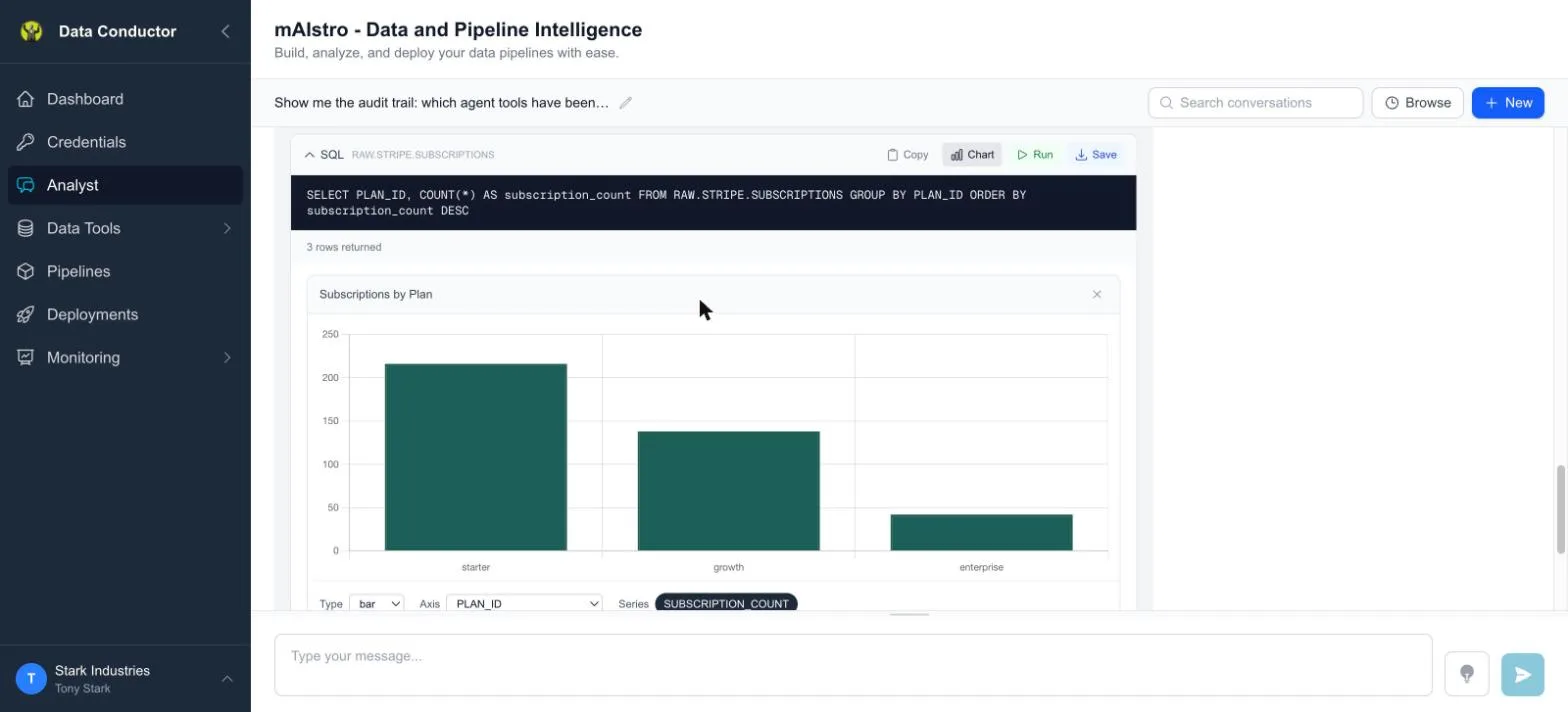
Every result grid has a Chart button — in chat and in the SQL editor. Press it and the type and axes come from the shape of the data.
New this week: you can ask in words. "Show me that as a bar chart" now draws one, from the rows the query actually returned rather than numbers retyped into a reply.
Two decisions worth stating, because they are the ones people notice:
It warns instead of refusing. A twelve-slice pie draws, with a note that
past about seven they stop being comparable by eye. A line on a
non-date axis draws, with a warning that it joins points in the order the
query returned them — which matters, because that chart will show a
confident trend that is really just your ORDER BY.
It never decides a chart would be nice. When a result would plot and nobody asked, you get a Show as chart button. One click. Nothing is drawn until you press it.
What these three are, together
A pipeline that reads from your warehouse, asks a model whether the numbers look right, calls your own function when they do not, and lets you look at the result as a chart while you decide what to do about it.
Each of those used to be a person.
Deeper pieces on each are coming — the interesting part is never the feature, it is the shape of the problem it removes. In the meantime the docs are up: HTTPS endpoints, cloud functions as steps, agents, the Analyst.